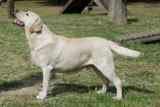
The photograph shows a yellow Labrador. It is Yellow Labrador Retriever 2 by SixtyWeb, CC BY-SA 3.0, via Wikimedia Commons.
Why Labradors are always hungry is a question with a research paper behind it, not a slogan. This article tells you which page to open and which feeding habits to write down. It does not restate the study’s figures. This is not veterinary advice.
Pages to open first
Open the University of Cambridge news page and read it yourself: Genetic variant may help explain why Labradors are prone to obesity. Then open the paper it points to: Raffan and colleagues, Cell Metabolism, 2016. If a sentence in this article and those pages disagree, the pages control.
For body shape, open the WSAVA nutrition guidelines and use the chart on that site rather than a description here: WSAVA Global Nutrition Guidelines.
For how you handle the food bag and the bowl, open the FDA page and follow it: FDA tips for safe handling of pet food and treats.
Your note on why Labradors are always hungry is unfinished until those four pages have been opened, or you have written “could not open” next to one of them and stopped.
What to copy into a notebook
Write the name of the gene only after you have seen it on the Cambridge page or in the paper. Do not copy a rate, a weight figure, or a breed comparison from a blog, including this one. If you want the figure, read it on the Cambridge page or in the paper and write the sentence in quotation marks with the date you read it.
Write whether a DNA test you are considering names that gene and links to a method page. If the test page does not name a method, write “not found.” A coloured result with no method is not a reading.
Write what your own dog does around food: begging at the counter, taking food from a side table, or finishing a meal and looking for more. Those are observations. They are not a diagnosis.
A feeding routine that does not invent an amount
This article does not set a daily amount. Ask a veterinarian to set the amount for this dog, and write that instruction down. Until you have it, do not change the amount you already feed because of a gene story.
If a veterinarian has given you an amount, measure that amount the same way each day. A scoop that is “about right” is not the instruction. Use the tool the clinic named, or a kitchen scale if they told you to weigh.
If you train with food, take the training pieces from the amount the clinic already set, if they told you that is allowed. If they did not, ask before you add a pocket of biscuits on top.
Slow the meal with a puzzle toy or by scattering the same amount you already measured. You are changing the time, not the amount, and only if the clinic has not told you otherwise.
Body shape, not a headline
Open the WSAVA chart and ask a veterinarian to show you how they score your dog. Write the score they give you and the date. Do not invent a score from a photo online.
Look again on a schedule you write down, such as the next clinic visit. A single hungry evening is not a new plan.
House rules that are just doors and lids
Close the bin. Close the cupboard. Keep the bag where the dog cannot open it. Those are household steps. They do not treat a gene. They do stop an unplanned extra meal.
If the dog has already taken something that worries you, call a veterinarian or a poison line your clinic has given you. This article does not list foods or amounts.
What a test result does not change
A line on a DNA report does not replace the clinic’s feeding instruction. It can sit in the notebook next to the Cambridge page so you remember where the idea came from. It is not permission to add food, and it is not permission to cut food without the clinic.
Breeders who use a test should read the paper and the test method page, then talk with a veterinarian who knows their breeding programme. This article does not tell anyone which dog to breed.
A sequence
- Open the Cambridge page and the 2016 paper.
- Open the WSAVA chart and the FDA handling page.
- Write observations about this dog. Do not write a diagnosis.
- Ask a veterinarian before you change the amount.
- If they set an amount, measure it the same way each day.
- Keep training pieces inside that amount only if they said so.
- Close the bin and the cupboard.
That sequence is the practical answer this page will give to why Labradors are always hungry. The research answer is on the Cambridge page and in the paper, not in a rewritten figure here.
What this article does not do
It does not state how common a variant is, how much weight it is linked to, or what to feed. It does not diagnose hunger. It is not veterinary advice. If your dog’s appetite changed suddenly, call a veterinarian rather than a gene article.
Questions readers ask
Does a gene mean my Labrador should eat more?
No. Read the paper, then ask a veterinarian before you change the bowl.
Should I order a DNA test?
Only if the test page names the gene and a method you can read. A result does not replace a clinic visit.
Can I use body condition instead of a scale?
Use the WSAVA chart with a veterinarian. Do not score from this article.
Is this veterinary advice?
No. This is not veterinary advice.
How to read the paper without turning it into a plan
When you open the 2016 paper, write the title, the year, and the journal name in the notebook. Write the names of the breeds the abstract mentions only if you copy them from the abstract, in quotes. Do not add breeds the abstract does not name.
If the Cambridge news page and the paper use different wording, keep both quotes and do not blend them into a new sentence. A blended sentence is how a figure gets detached from its source.
If you cannot open the paper, stop at the Cambridge page and write “paper not opened.” Do not fill the gap with a forum post.
Share the notebook with the clinic if you want their view. Bring the quotes, not a summary you wrote from memory.
Day-to-day notes that stay boring on purpose
For one week, write the time you put the bowl down and the time you pick it up. Write whether the measured amount, if you have one from the clinic, was the same as yesterday. Write whether anyone else in the house added a piece of food. That last line is the one people skip.
Do not write a calorie figure unless it is printed on the bag and you are copying the bag, and even then do not turn it into a target. The target, if there is one, comes from the clinic.
At the end of the week, you have a record. You do not have a diagnosis. Take the record to the clinic if the dog’s shape or appetite is a worry.
Repeat the week after any change the clinic actually asked for. One day is not a test of the change.
What to ignore online
Ignore a chart that does not link to the 2016 paper or the Cambridge page. Ignore a feeding calculator that asks for a gene result and then prints an amount. Ignore a supplement offer that mentions hunger and a checkout button. None of those is the paper.
Ignore a sentence that says every Labrador has the variant, or that no Labrador has it, unless that sentence is a quote you can point to on the Cambridge page or in the paper. If you cannot point to it, delete it from your notes.
The question why Labradors are always hungry is worth a paper and a clinic visit. It is not worth a product.