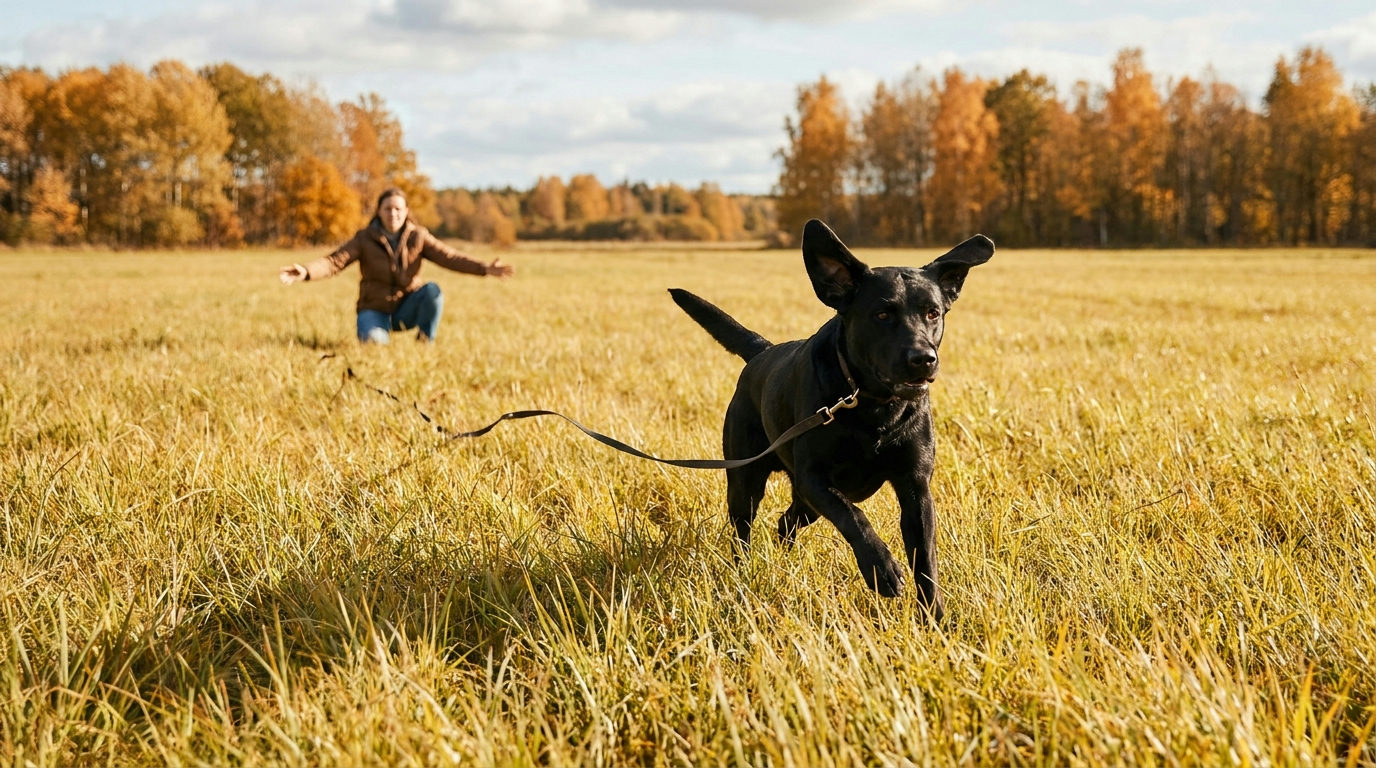
Labrador recall training works best when coming back to you is the most rewarding thing your dog can do, every single time. Start indoors with no distractions, use one clear cue, pay generously with food or play, and move outdoors on a long line before you ever trust your Labrador off-lead. Most recall problems come from skipping steps, not from a stubborn dog.
Why recall matters so much for Labradors
Labradors are friendly, curious and driven by their noses. That is a lovely combination at home and a risky one near a road, a river in flood or a picnic. A dependable recall is the skill that lets you enjoy walks without constantly worrying.
The American Kennel Club’s guide to reliable recall makes a point worth repeating: every time you call your dog, you are asking it to turn away from something interesting. Your job is to make yourself more interesting than whatever that is.
Before you start: three ground rules
- Choose one cue and protect it. Pick a word or whistle you will use only for recall, such as “Here” or two short pips. If “Come” has been used and ignored a hundred times, start fresh with a new cue.
- Never call your dog for something unpleasant. The AKC’s recall tips warn against using the recall cue before a bath, nail trim or telling-off. If you need your dog for something it dislikes, go and get it instead.
- Never punish a dog that comes back. Even if it took five minutes and your patience is gone, the moment your Labrador arrives is the moment to celebrate.
Step-by-step Labrador recall training
Stage 1: Charge the cue at home
In a quiet room, say your cue once and immediately give a high-value treat, even though your dog is right next to you. Repeat this five to ten times in a session, a couple of times a day. You are teaching your Labrador that the cue predicts something wonderful.
Stage 2: Short-distance recalls indoors
Wait until your dog is a few steps away and not too busy. Say the cue once, in a happy voice, and back away a couple of steps to encourage it to follow. When it reaches you, reward, gently touch the collar or harness, and then release it to go back to what it was doing. Touching the collar teaches that being caught is not the end of fun.
Stage 3: Add rooms and people
Call from another room, or play “round-robin” between two family members standing apart, each calling and rewarding in turn. Keep it short and stop while your dog is still keen.
Stage 4: Go outside on a long line
Move to your garden, then a quiet park, with your dog on a long line. The AKC suggests a line of around 15 to 20 feet so your dog can explore while you stay in control and within leash laws. The line is a safety net, not a way to reel your dog in. Call once, reward generously, release.
Stage 5: Build distractions slowly
Add one challenge at a time: a sniffy patch of grass, a person at a distance, then another dog far away. If your Labrador ignores you, the step was too big. Move further from the distraction, use a better reward, and try again.
Rewards that actually compete
For most Labradors, food is the strongest currency. Use something better than ordinary kibble for recall practice, such as small pieces of cooked chicken or a favourite training treat. Many Labradors also love a quick game of tug or a thrown toy as a reward. To keep calories in check, count training treats as part of the daily food allowance. Our guide to treats for Labrador training has ideas.
Common recall mistakes
- Calling repeatedly. “Come, come, COME!” teaches your dog the first two calls are optional. Say it once, then help your dog succeed by moving away or making exciting noises.
- Only calling at the end of a walk. If recall always means the lead goes on and the fun stops, your dog will learn to avoid it. Call, reward and release many times during every walk.
- Chasing. To a Labrador, being chased is a great game. Run the other way instead, and your dog will usually follow.
- Going off-lead too soon. Every successful ignored recall teaches your dog that ignoring works. Keep the long line on until recall is solid in that environment.
When recall is not safe to rely on
Even a well-trained Labrador may struggle near livestock, wildlife, water or a busy road. The AKC is clear that you never need to let your dog off-lead if you are not confident, and that local leash laws always apply. Choosing to keep your dog on a long line is responsible, not a failure.
The bottom line
A reliable recall is built, not found. Charge one cue at home, reward every return like it matters, and add distance and distractions in small steps on a long line. Stay patient, avoid calling for anything unpleasant, and keep practising throughout your Labrador’s life. The payoff is a dog that comes flying back when you call, and walks you can both genuinely enjoy.