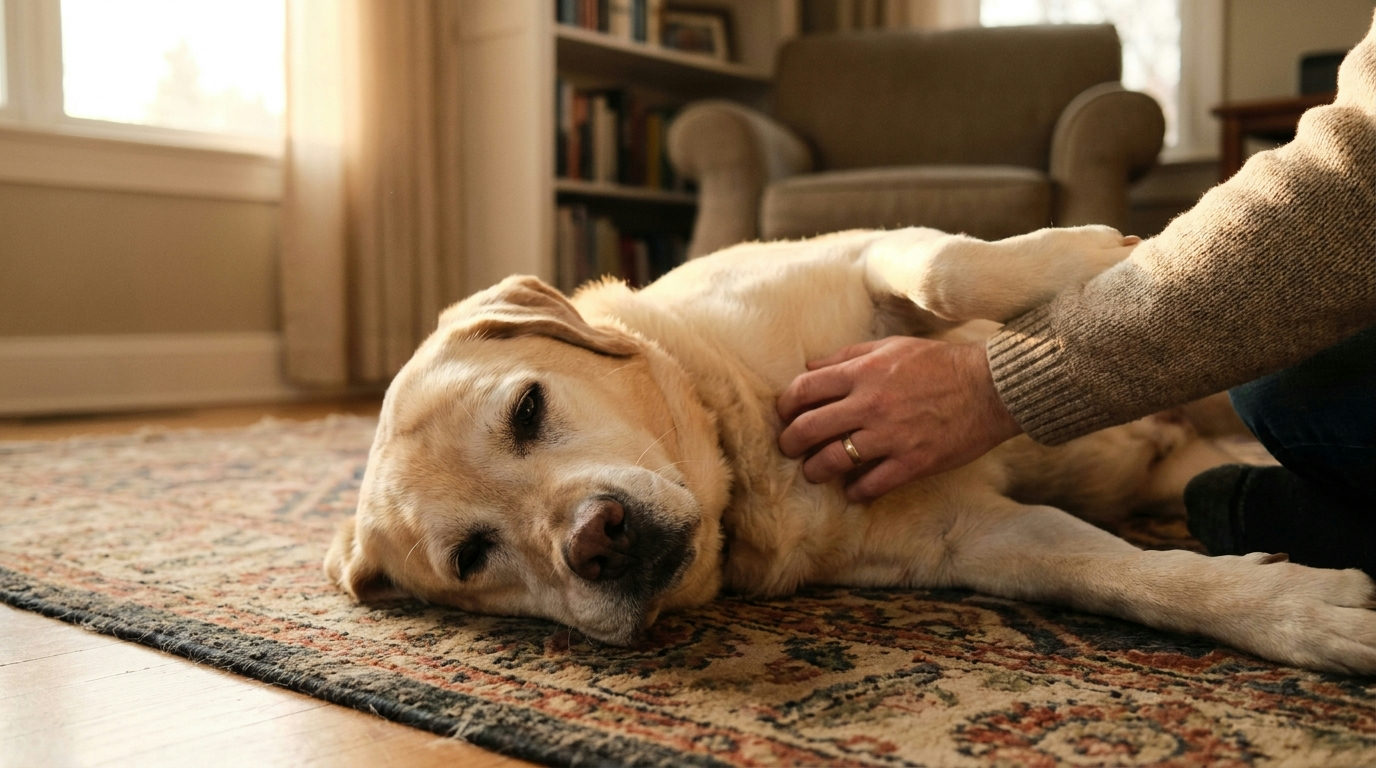
Fatty lumps on Labradors are very common, and most turn out to be lipomas: soft, slow-growing, non-cancerous growths of fat under the skin. The catch is that you cannot tell a harmless lipoma from something more serious just by feeling it. Any new lump deserves a quick vet check, which usually means a simple needle test that takes a few minutes. This guide explains what lipomas are, why Labradors get so many, how a vet tests a lump, when removal makes sense and how to keep track of lumps at home.
Disclaimer: This content is for informational purposes only and is not medical or veterinary advice. Consult your veterinarian about any lump or change you find on your dog.
What is a lipoma?
A lipoma is a benign tumour made of fat cells. According to the Cornell Richard P. Riney Canine Health Center, lipomas are one of the most common benign tumours in dogs. They are typically round, soft and movable, and usually sit just under the skin on the chest, belly, sides or upper legs. A dog may have one, or several, and a Labrador that develops one lipoma in middle age often develops more over the following years.
Why Labradors get them
The exact cause of lipomas is unknown. Cornell notes that older dogs, overweight dogs and certain breeds, including Labrador Retrievers, are more likely to develop them. Given how easily many Labradors gain weight, it is no surprise that owners of middle-aged and senior Labs find fatty lumps so often. Age matters too: a lump on a two-year-old is far less likely to be a lipoma than the same lump on a nine-year-old, which is one reason your vet will ask your dog’s age before anything else.
Not every fatty lump is the same
Simple lipomas
The usual kind. They grow slowly inside a thin capsule and tend to stay put. Many never cause any trouble.
Infiltrative lipomas
Less common. Cornell explains that these push into surrounding muscle, bone or nerves. They are still benign, but they tend to grow faster and are more likely to come back after removal.
Liposarcoma
A rare malignant tumour of fat cells. It rarely spreads to other parts of the body but often invades nearby tissue, so it needs a different treatment plan.
Other types of tumour, including some that are more serious, can feel very similar to a lipoma under the fingers. That is the main reason vets test rather than guess.
What fatty lumps on Labradors typically feel like, and what they do not
None of these signs replace a test, but they help you describe fatty lumps on Labradors accurately to your vet and notice change between visits.
- Typical of a lipoma: soft or slightly rubbery, round or oval, moves freely under the skin when you push it, not painful, skin over it looks normal, grows slowly over months.
- Worth mentioning promptly: firm or hard, fixed to the tissue underneath, irregular edges, grew noticeably within a few weeks, skin over it is red, ulcerated or hairless, your dog flinches when you touch it.
- Location matters: lumps in the armpit, groin, behind the knee or on a limb can interfere with movement even when benign, and lumps near a mammary gland or on the lower jaw are handled differently from body-wall lumps.
How your vet checks a lump
Your vet will start by feeling the lump and asking how long it has been there and whether it has changed. The next step is usually a fine needle aspirate (FNA). Cornell describes this as a minimally invasive test where a small needle is used to collect cells from the lump so they can be examined under a microscope.
Most dogs tolerate an FNA about as well as a vaccination, and it is often done in the consulting room without sedation. If the sample shows only normal fat cells, that strongly supports a lipoma. If the result is unclear, or the lump behaves unusually, your vet may suggest a biopsy or imaging.
What to expect at the appointment
- History. When you first noticed it, how fast it has grown, whether it bothers your dog, and whether there are other lumps.
- Full-body check. Vets usually feel the whole dog, not just the lump you came in about, since Labradors with one lipoma often have others.
- Needle sample. One or more passes with a thin needle, usually with no sedation. Some clinics read the slide in-house; others send it to a laboratory, which takes longer.
- The plan. Monitor, remove, or investigate further. Ask your vet to write down the lump’s size and location so the record starts on day one.
Questions worth asking
- Did the sample contain only fat cells, or was there anything else?
- Would you re-test if it grows, and how much growth would prompt that?
- Is its position likely to affect walking, lying down or harness fit as it grows?
- If we remove it, would you send the tissue for histopathology?
When a lipoma needs treatment
Not every lipoma needs to come out. Many vets simply monitor a confirmed simple lipoma. Removal is more likely to be discussed when a lump:
- Grows quickly or changes shape or texture
- Sits somewhere that affects movement, such as the armpit or between the legs
- Becomes large enough to be uncomfortable
- Is confirmed or suspected to be infiltrative
- Gives an unclear test result
Smaller lumps are generally simpler to remove than large ones, which is another reason not to wait and see without a diagnosis.
If surgery is recommended
Removing a simple lipoma is usually a routine procedure under general anaesthetic, and many vets will take it out alongside another planned procedure, such as a dental, to avoid a second anaesthetic. Expect a shaved patch, a line of stitches or glue, and a cone or recovery suit for around ten to fourteen days while the skin heals. Keep your Labrador on lead walks and out of water until your vet has checked the wound. Ask whether the removed tissue will be sent to a laboratory; histopathology on the whole lump is the only way to be certain of the diagnosis, and it tells your vet whether the margins were clean.
How to keep track at home
Checking for fatty lumps on Labradors is easy because most love a belly rub. Make it a monthly habit:
- Run your hands slowly over your dog from nose to tail, including the chest, belly, armpits, legs and tail.
- When you find a lump, measure it with a ruler or tape and note its location.
- Take a clear photo with a coin or ruler beside it for scale.
- Keep a simple “lump map” in your phone with dates, sizes and your vet’s findings.
This record is genuinely useful to your vet. It turns “I think it’s got bigger” into a clear answer. A practical trick for dogs with several lumps is to sketch a rough outline of your dog on paper, number each lump, and keep the numbering consistent so you and your vet are always talking about the same one.
Living with lipomas
Many owners live with several fatty lumps on Labradors for years without any problem. A few practical adjustments help. Check that harness straps and collar edges do not rub over a lump, especially on the chest and shoulders, and switch to a different fit if they do. Groomers should know where the lumps are so clippers do not nick the skin over them. If a lump sits on the elbow or hip, a well-padded bed reduces pressure. Most of all, keep the monthly check going even when the known lumps are stable, because the goal is to spot the new one, not to re-measure the old ones.
Can you prevent lipomas?
There is no proven way to prevent lipomas, and no home remedy has good evidence for shrinking them. Because excess weight is linked to a higher risk, keeping your Labrador lean is the most sensible step you can take. Our guide to Labrador weight management strategies covers the practical side.
Common mistakes owners make with fatty lumps on Labradors
- Assuming the second lump is the same as the first. A dog with a confirmed lipoma can still develop a different kind of tumour. Each new lump needs its own check.
- Waiting until a lump is large. Large lumps are harder to remove cleanly and leave bigger wounds.
- Trusting a photo from the internet. Appearance alone cannot distinguish a lipoma from a mast cell tumour or soft-tissue sarcoma; only cells under a microscope can.
- Trying supplements or creams instead of testing. They delay a diagnosis and have no reliable evidence behind them.
When to see the vet promptly
Book an appointment soon if you find any new lump, and sooner if a lump is growing quickly, feels hard or fixed in place, is red, hot, painful or bleeding, or appears alongside weight loss, lethargy or changes in appetite. For a wider look at conditions to watch, see our Labrador health guide to 12 common conditions.
Frequently asked questions
Can fatty lumps on Labradors go away on their own?
Simple lipomas rarely disappear. Some shrink slightly if an overweight dog loses weight, but most stay the same or grow slowly. Any lump that shrinks and grows repeatedly should be looked at, because that pattern is more typical of other kinds of swelling.
Is a needle test enough, or does my dog need a biopsy?
For many lumps an FNA gives a clear answer. If the sample is unclear, mostly blood, or does not match how the lump is behaving, your vet may recommend a biopsy or removal with histopathology.
Should I have a confirmed lipoma removed just in case?
Not usually. Vets generally monitor confirmed simple lipomas and reserve surgery for lumps that grow, cause discomfort or restrict movement. Discuss your dog’s age, anaesthetic risk and the lump’s position with your vet.
The bottom line
Most fatty lumps on Labradors are harmless lipomas, but “most” is not “all”. Have every new lump checked with a quick needle test, keep a simple record of sizes and locations, and keep your dog at a healthy weight. That approach catches the rare serious lump early and saves you months of worrying about the harmless ones.