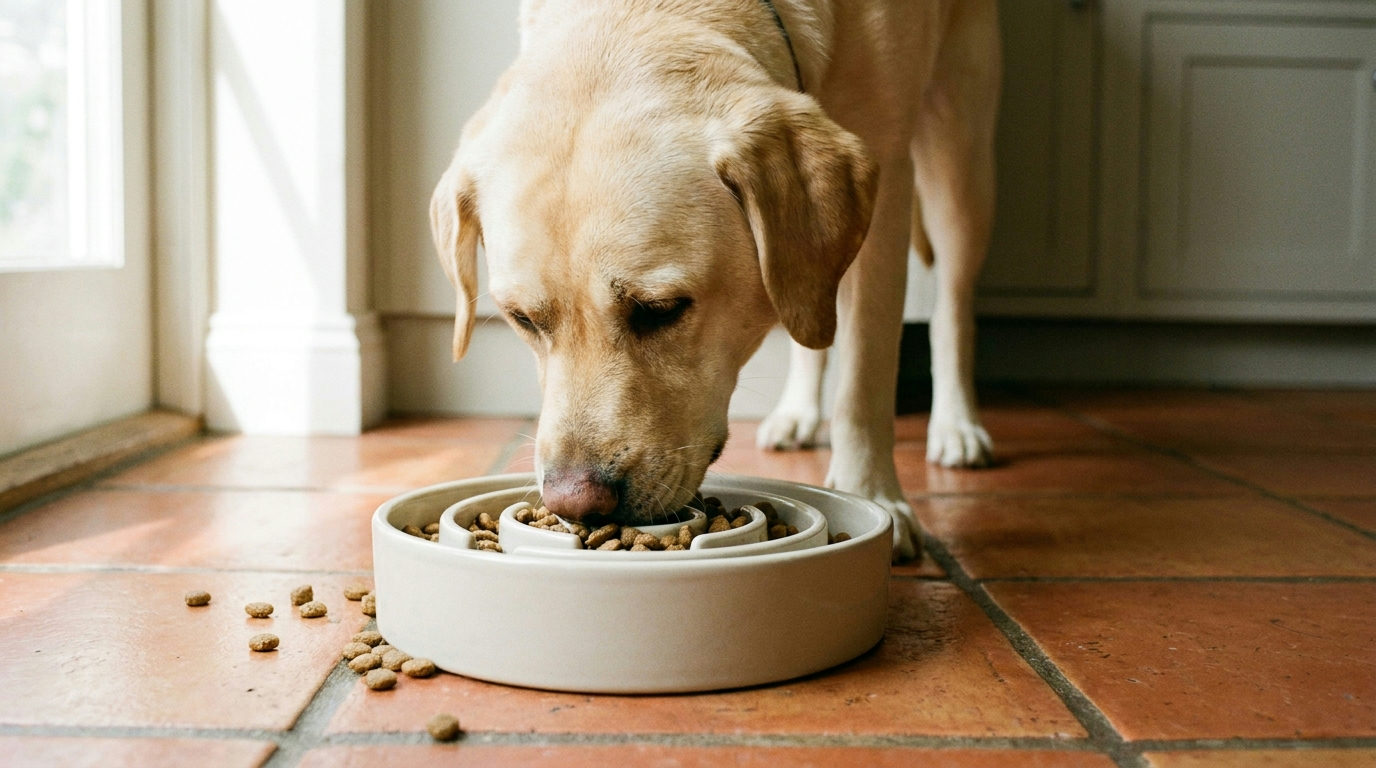
A slow feeder bowl for a Labrador uses ridges, mazes or other obstacles to stop your dog inhaling a meal in seconds. For many food-driven Labs it makes mealtimes longer, calmer and more satisfying. The right one is sturdy enough for a large dog, easy to clean, and challenging without being so frustrating that your Labrador gives up or starts chewing the bowl.
Disclaimer: This content is for informational purposes only and is not medical or veterinary advice. Consult your veterinarian about your dog’s feeding plan, especially if your dog has had digestive problems.
Affiliate disclosure: Labrador Healthcare may earn a commission if you buy through links on this site, at no extra cost to you. We have not hands-on tested specific products for this guide; it sets out the selection criteria we recommend.
Why fast eating matters for Labradors
Plenty of Labrador owners have watched a full bowl vanish before they have straightened up. Beyond the comedy, fast eating can cause gulped air, regurgitation and vomiting straight after meals.
There is also a more serious reason to pay attention. The Cornell Riney Canine Health Center lists eating too quickly among the factors that may increase the risk of gastric dilatation-volvulus (GDV, or bloat), a life-threatening emergency most common in large, deep-chested dogs. Other listed factors include feeding one large meal a day, using a raised bowl and exercising soon after eating.
An honest note on the evidence
Research such as the 2000 Glickman study of large and giant breeds identified fast eating as a risk factor for GDV. That does not prove a slow feeder prevents bloat, and no product can promise that. A slow feeder is a sensible way to change one risk factor, alongside smaller meals and rest after eating. If you are worried about bloat, talk to your vet, and read our guide to Labrador bloat prevention.
The main types of slow feeder
Ridged or maze bowls
The most common style. Raised ridges or spirals force your dog to work around them. They are simple, affordable and a good first choice for most Labradors.
Puzzle feeders
These use sliding panels, lids or compartments your dog has to move. They are great mental exercise, but some Labradors learn to solve them quickly, and others get frustrated. They are usually better for part of a meal than the whole thing.
Lick mats and snuffle mats
Lick mats suit wet or spreadable food; snuffle mats hide dry kibble in fabric strips. Both slow eating and add enrichment, but snuffle mats need close supervision with dogs that chew fabric.
Inserts for your existing bowl
A slow-feed insert sits inside a standard bowl. It is a good budget or low-waste option if you already own a solid stainless steel bowl.
How to choose a slow feeder bowl for a Labrador
- Size and depth: it should hold a full Labrador meal without overflowing. Many slow feeders are sized for small dogs.
- Stability: a non-slip base or weighted design stops an enthusiastic Lab pushing it around the kitchen.
- Difficulty: start with a moderate pattern. If your dog gives up, walks away or starts chewing the bowl, choose something easier.
- Material: stainless steel and ceramic are durable and easy to clean. If you choose plastic or silicone, look for food-safe materials and replace the bowl if it becomes scratched or chewed.
- Cleaning: deep grooves trap food and bacteria. Check the bowl is dishwasher-safe, or that a brush can reach every corner.
- Floor level: given the evidence around raised bowls and bloat in large breeds, many owners keep a Labrador’s bowl on the floor unless their vet advises otherwise.
Introducing a slow feeder
- Start with the easiest setting or a simple ridged bowl.
- For the first few meals, scatter a little food on top so early success is easy.
- Stay nearby and watch. Praise calm eating.
- If your dog seems stressed or starts chewing the feeder, go back a step.
Always pick the bowl up after the meal if your dog is a chewer. A slow feeder is a feeding tool, not a toy.
Other ways to slow a fast eater
- Split the daily ration into two or three smaller meals.
- Scatter-feed part of a meal on a clean lawn.
- Use part of the ration for short training sessions.
- Feed dogs separately if competition makes your Labrador gulp.
- Allow a quiet rest period after meals rather than heading straight out for a run.
The bottom line
A well-chosen slow feeder bowl can turn a ten-second Labrador meal into a calmer few minutes and give a food-driven dog something rewarding to work on. Choose a sturdy, stable, easy-to-clean design sized for a large dog, introduce it gently, and combine it with smaller meals and rest after eating. For any concerns about bloat or digestion, your vet is the right person to guide the plan.