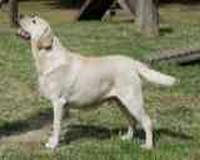
The photograph is a yellow Labrador. It is Yellow Labrador Retriever 2 by SixtyWeb, CC BY-SA 3.0, via Wikimedia Commons.
OFA vs PennHIP is a paperwork choice, not a diagnosis. This page tells you which official pages to open and what to write down. It does not grade a hip, name an age, or report a study result. This is not veterinary advice.
The three pages
Open the Orthopedic Foundation for Animals hip dysplasia page and read it yourself: OFA hip dysplasia. If this article and that page disagree, the page controls.
Open the PennHIP page on the Antech Imaging Services site and read it yourself: PennHIP. Write the name of the organization that page says runs the method.
Open the American Kennel Club overview and read it yourself: AKC hip dysplasia in dogs. Use it as a plain-language page, not as a substitute for the two method pages.
Your OFA vs PennHIP notes are finished only when each page has a line in your notebook. A memory of a forum post is not a line.
What to copy from the OFA page
Copy the sentence that says what the evaluation looks at. Do not paraphrase it into a scale unless the page prints the scale. If the page prints a scale, copy the words, not a summary.
Copy the sentence about when a final result is available, if the page has one. If you cannot find that sentence, write “not on this page” instead of filling a blank from memory.
Copy who reads the image, in the page’s words. Copy what the owner receives. Copy whether the page says a younger dog can have a preliminary look, and copy that sentence whole.
Write the date you opened the page. Pages change. A note without a date is hard to trust later.
What to copy from the PennHIP page
Copy the sentence that says what is measured. If the page names a number, copy the name and the sentence that defines it. Do not invent a range.
Copy the sentence about who may take the images. If the page says a clinic must be trained, write that requirement in the clinic’s column, not as a guess about your own clinic.
Copy any sentence about sedation only if it is on that page. If it is not on that page, leave the line blank and ask the clinic.
Copy how results are compared, in the page’s words. If the page says results are set against other dogs, write that. Do not add a breed ranking the page does not print.
A two-column sheet
Make two columns labeled with the names on the two pages. Under each column, use the same questions:
- What does the page say the pictures are for?
- Who does the page say may take them?
- What paper or report does the page say you receive?
- What does the page say about a dog that is not yet an adult, if it says anything?
- What does the page say you should ask a breeder to show you?
Leave a box empty when the page is silent. An empty box is more honest than a borrowed fact.
Questions for the clinic
Call the clinic with the sheet in front of you. Ask which of the two methods they can actually perform. Write the answer in their words.
Ask what the visit includes and what they need from you before the day. Ask which page they want you to read first. Ask what you will hold in your hand when you leave.
Ask what they do if the dog already has a result from the other method. Write that answer. Do not decide the two results match or conflict unless both reports are on the table and the clinic says so.
If the clinic names a fee, write the fee they named and the date. Do not publish a fee from memory, and do not treat one clinic’s fee as the price everywhere.
Questions for a breeder or a rescue
Ask which method the parents were screened with, and ask to see the report, not a screenshot of a slogan. Write the report identifier the paper shows.
If they say hips were checked without naming a page, ask them to name the page. A word with no report is not a result.
Ask whether any other joint screen is in the same folder. This article does not rank those screens. It only tells you to look at the paper they offer.
If you are adopting and no paper exists, write “no paper” and take that fact to the clinic. Do not invent a result for a dog you have not met.
What this comparison is not
OFA vs PennHIP on this page is not a winner. It is not a claim about arthritis, pain, or how a dog will move. It is not a breeding recommendation. Those sentences belong on the official pages or in a clinic conversation, copied, not guessed.
Do not quote a study in your notes unless you opened the study. A magazine line about a study is not the study. If you want the study, ask the clinic for the citation and open it.
Do not use this article to skip an exam. A dog that is stiff or lame needs the clinic, not a screening chart.
How to store the papers
Keep the OFA report and the PennHIP report in one folder with the dog’s name on it. Write the date you filed each one. Photograph the pages so a drawer is not the only copy.
If a later clinic asks for the report, send the file they name. Do not retype a score into an email if you can attach the original page.
If you move, the folder moves with the dog’s other papers. A result you cannot find is the same as a blank form on the day someone asks.
A sequence
- Open the OFA page and copy only what it prints.
- Open the PennHIP page and copy only what it prints.
- Open the AKC overview and note anything it says that the two method pages also say.
- Build the two-column sheet. Leave blanks.
- Ask the clinic which method they perform and what the visit includes.
- If you are buying or adopting, ask for the parents’ or the dog’s actual report.
- File the report the day you receive it.
That sequence is the job. The visit is one step, not the comparison itself.
Questions readers ask
Which method is more accurate?
This article does not answer that. Open both official pages and ask the clinic. If a page states a comparison, copy that sentence and keep the link.
Can I do both?
Ask the clinic. Write what they say about doing one, the other, or both. Do not assume a second visit is required or forbidden.
Is a puppy too young?
Read the age line on each official page, if it has one, and copy it. If your question is about your own dog, ask the clinic. This is not veterinary advice.
What if the two reports use different words?
Keep both reports. Ask the clinic to explain the words on the pages you hold. Do not translate one scale into the other from a blog.
Before you pay
Read the clinic’s estimate. Ask what is included and what is a separate line. Ask which database or registry receives the images. Write those names.
Ask how you will correct a wrong spelling of the dog’s name. A report with the wrong name is hard to show a buyer later.
Ask how long the clinic says the images are kept. Write that. If they do not know, write that too.
The decision in OFA vs PennHIP is which pages you opened and which clinic can do the work. It is not a slogan and it is not a score you invent at the kitchen table.
When the report arrives, read it next to the official page, not next to a social post. If a word on the report is not on the page you saved, ask the clinic what the word means before you repeat it.
If you later share the result with a buyer or a rescue, share the report. A sentence you wrote is not the certificate.