Exercise induced collapse in Labradors is a subject with a public genetics page, not a diagnosis you can finish at the kitchen table. The page to open first is the University of Minnesota Canine Genetics Lab page on exercise-induced collapse. A second public page is the University of Saskatchewan Veterinary Medical Centre note. Read those pages in their own words. This article will not restate their medical findings, and it will not turn a screenshot into a plan for your dog.
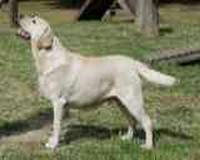
This is not veterinary advice, a diagnosis, or a treatment. If your Labrador is in distress, stop the activity and contact a veterinarian or an emergency clinic. Do not wait to finish this article, and do not use it to decide how long to watch. The photograph is Yellow Labrador Retriever 2 by SixtyWeb, CC BY-SA 3.0, via Wikimedia Commons. It is a licensed photograph of a dog, not a generated scene and not a picture of a laptop keyboard.
Exercise induced collapse in Labradors appears in this piece only as the name of the topic on those pages and as the reason you might ask your own clinic a question. If this article and either university page disagree, the university page controls. If the clinic and the page disagree about your dog, the clinician who has examined the dog controls. A blog does not outrank either of them.
Exercise induced collapse in Labradors starts as a page you can open
Copy the address of the Minnesota page into a note, and write the date you opened it. Pages change. An undated printout is harder to compare later. If the page has a heading you want the clinic to see, copy that heading in their words and say it is a heading, not your conclusion. Do not paraphrase a medical sentence into a shorter claim and then treat the shorter claim as the source.
Do the same with the Saskatchewan page. Two pages are two notes. If they use different labels for the same test, keep both labels and ask the clinic which label matches the laboratory they use. Do not merge the pages into one sentence that neither institution wrote. A merged sentence is how a careful page becomes an unsupported claim.
If a link on either page does not open, write that it did not open. Do not replace it with a different organisation’s story, and do not fill the gap with a number you remember from an older draft. An older draft of this topic carried ages, durations, temperatures, and percentages. Those sentences are not in this version because they are medical claims this article refuses to repeat.
What you copy, and what you leave on the page
Copy the name of the laboratory, the name of the test if the page prints one, and the date. Copy the words they use for a result category only as a quotation you can point at, and only if you will show the clinician the same page. Do not turn a quotation into a prediction about your dog. A category on a public page is a label the laboratory defined. It is not a description of the afternoon you just had.
Leave on the page any sentence about what an episode looks like, how long it lasts, how hot a dog becomes, or how often a result appears in a tested group. Those sentences may be true on the page that wrote them. They are not yours to shorten, round, or apply to the dog in front of you. This article deletes them rather than half-cite them.
Leave dosing off the note entirely. This article has no dose, no supplement, and no cooling recipe. If a caregiver asks what to give, the answer is to call the clinic, not to borrow a line from a blog. A product name belongs on the note only when you already give that product and the clinic asks for the label.
How to describe your own dog without deciding the cause
Write what you saw in ordinary words: which activity was happening, when it started, and whether the dog is now resting, walking, or in distress. Use the clock time you actually have. If you do not know the minute it began, say you do not know. A precise-looking guess becomes part of the history and is harder to undo than a blank.
Do not title the note with the condition. The title of this article is the search topic. The title of your note should be the observation. A clinician needs the observation before deciding whether the genetics page is even the right page for this visit. Other problems can look urgent. This article will not list them, because a list of diseases is itself a claim.
If you already have a short video made without causing distress, ask the clinic whether they want it and how to send it. Do not repeat the activity to get a clearer recording. A better video is not worth a worse afternoon. If the dog is in distress now, the call comes before the file transfer.
Questions that belong on the visit card
Ask whether the observation needs an examination, which records the team wants, and which changes should make you call again before the appointment. Ask whether a genetics test is relevant to this dog, and which laboratory they want if they want one. Do not order a test because a blog named a university. The clinic may want a different assessment first.
Ask what a result would and would not tell them about this dog. A public page can explain a test in general. Only the clinician can say whether that explanation applies to the animal they are examining. Write their answer in their words. If you do not understand a word, ask them to repeat it. Do not replace it with a synonym from this article.
Ask who to call after hours, and write that number where every caregiver can see it. A genetics page is not an emergency service. The University of Minnesota page and the University of Saskatchewan page are reading, not a clinic that has your dog’s file. Keep the two kinds of page in two different lines of the note.
A result sheet is a document, not a plan you invent
If a result arrives, file the full sheet with the dog’s name, the laboratory name, and the date. Photograph the whole page if you are allowed to keep the image, including the part that explains the categories. Do not crop away the explanation and keep only a single word. A single word without the laboratory’s sentence is how a result gets misread.
Bring the sheet to the clinic rather than announcing what it means at home. Ask which animal the sheet identifies. A parent’s result is not the puppy’s result. A result from a different dog in the household is not this dog’s result. If the name or the identification number does not match, say so before anyone treats the paper as settled.
If you are choosing a puppy and a breeder offers paperwork, ask which animal was tested and ask to see the laboratory page, not only a sentence in an email. Store the paperwork with the date you received it. This article does not say which pairing is acceptable. That is a question for the laboratory’s own explanation and for a veterinarian who advises on breeding, not for a blog.
Keep the household on one card
Write who walks the dog, who feeds the dog, and who is allowed to call the clinic. A second person may have seen a different afternoon. Add their note underneath, with their name and the date, instead of editing the first note until it sounds smoother. Two observations can both be useful. A blended observation that nobody actually saw is not.
If a family member finds an older article that lists ages, minutes, or percentages, do not copy those figures onto the card. Send them to the university page instead. The older figures were the reason a previous draft of this piece was rejected. Repeating them, even with a link nearby, is how the same claim comes back.
Do not add a supplement, a new food, or a training plan in order to feel that the afternoon had a remedy. The remedy, if there is one, is the clinic’s instruction after an examination. Until that instruction exists, the card holds the observation, the page addresses, and the phone number. That is a complete card.
What this article will not do
It will not describe an episode, rank how common the topic is, or say which age of dog is typical. It will not compare body temperature with exercise, and it will not tell you how to cool a dog. It will not name a gene and then explain the nervous system. Those sentences belong on the pages that researched them, in the form those pages chose, read on the day you open them.
It will not tell you that a result means the dog is safe to exercise, or that a result means the dog must stop a particular game. Exercise decisions are individual. Ask the clinician who has examined your Labrador. If they give a limit, write the limit in their words, including what activity it covers and when they want to review it. Do not generalise that limit to another dog.
It will not cite a page that does not open. A foundation story that returned an error is not a source. The two links in the opening are the ones this article relies on, and only for the fact that the pages exist and should be read. Everything medical stays on those pages.
Where the note stops
The note stops when you have the page addresses, the date, the observation in ordinary words, and the clinic’s contact. It does not stop when you have a theory. A theory is optional and should be labelled as a question, not as a finding. The finding, if any, comes from the examination and from documents that name your dog.
Read the Minnesota page once more before the visit if the date on your copy is old. Read the Saskatchewan page the same way. Then put the phone in the same folder as the note. Exercise induced collapse in Labradors is a topic you can prepare for by reading and by calling. The practical tip is to copy both university addresses and your clinic’s after-hours number onto one dated card before you discuss the topic, and to leave every medical detail on the university page instead of rewriting it here.