Disclaimer: This content is for informational purposes only and is not a substitute for professional veterinary advice. Ask your veterinarian about your individual dog.
Here’s the direct answer on snow nose in Labradors: if your Lab’s nose looks lighter than it did in summer, the most useful thing you can do is write down what you see, take a few dated photos, and ask your vet about it at your next visit, sooner if anything other than the colour has changed. “Snow nose” is the everyday name owners use for a nose that seems to fade in colder months, and only your vet can confirm whether that is what your dog has. We are Labrador owners and careful researchers, not vets, so this guide is about observing well and asking good questions, not about diagnosing at home.
Here’s the direct answer, then the detail. Below we cover what owners usually mean by the term, a simple observation checklist, a photo routine that takes two minutes, how to sort what you are seeing into “mention it” versus “call now”, and the questions worth taking to your vet. Fair warning: the research here is thin, and we say so where it matters.
What owners mean by snow nose in Labradors
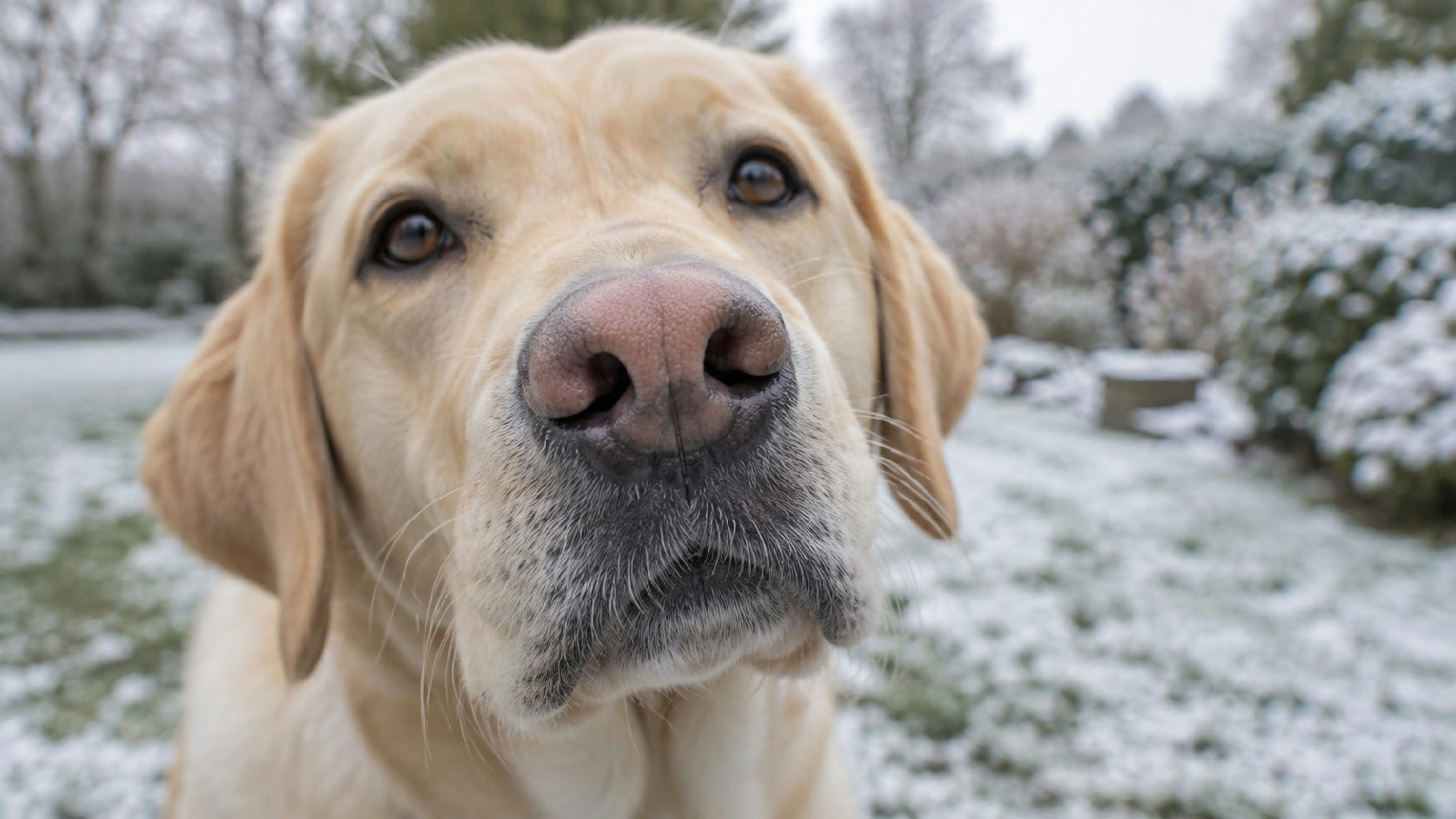
When people talk about snow nose in Labradors, they usually mean one thing: the dark leather of the nose (the hairless part at the tip, which vets call the nasal planum) looks lighter, pinker or browner than it used to. Some owners describe a pink stripe down the middle. Others say the whole nose looks “washed out” next to their summer photos.
That is a description of what owners notice, not an explanation of why. You will find several theories online about what is going on underneath, and we have deliberately left them out. The research here is thin, the sources we read are open about not having a settled answer, and we would rather send you to them than repeat theories as if they were facts. If you want the background, the American Kennel Club and PetMD both have owner-friendly pages, linked in the further reading section below.
In our experience as owners, a common pattern is that people notice the change on a yellow Lab first. That is almost certainly about visibility. A pinkish nose on a pale face is hard to miss, while the same change on a black Lab may slip past until someone points it out. It is not a claim about coat colour causing anything.
Snow nose vs a Dudley nose, in plain English
You may also hear the phrase “Dudley nose”. The AKC’s page on loss of pigmentation in dogs covers how the two terms are used differently. For our purposes the practical point is simple: if your Lab’s nose has always looked the way it looks now, tell your vet that. If it has changed, tell your vet that too, along with roughly when you first noticed. Your vet can confirm which description fits.
An observation checklist for your Lab’s nose
A short checklist gives you something to compare against later. Here’s what to note down, in the same phone note each time.
- Colour. Black, dark brown, pinkish, tan, patchy? Is the change across the whole nose or in one area, such as a central stripe or the edges?
- Surface and texture. Does the nose still have its usual pebbled, textured look? Or does any part look smooth, shiny, flaky, cracked or rough?
- Moisture. Does it look as it usually does for your dog, or noticeably drier or wetter than normal?
- Crusts, scabs or sores. Any at all, on the nose or where the nose meets the fur?
- Bleeding. Any spots of blood on the nose, on bedding, or on toys.
- Edges and spread. Do any pale areas reach beyond the nose, for example onto the lips, gums or around the eyes?
- Behaviour. Is your Lab rubbing or pawing at the nose, sneezing more than usual, or flinching when you touch the face?
- Date first noticed. A rough month is fine. “Around the first frosty mornings” is useful information.
If the honest answer to everything except the first line is “no change”, write that down too. “Colour only, nothing else different” is exactly the sentence your vet will want to hear, and it is much more helpful than “it looks a bit odd”.
A simple photo routine for snow nose in Labradors
Memory is a poor judge of colour, and indoor lighting makes things worse. A photo log gives your vet something real to compare. Here’s a simple routine.
- Pick one spot. Near a window with daylight, ideally out of direct sun. Same spot every time.
- Pick one angle. Straight on, at your dog’s eye level, plus one from the side. Two photos, no more.
- Turn the flash off. Flash tends to wash out colour on a dark nose.
- Bribe accordingly. A Labrador will hold almost any pose for a treat held just above the camera. This is the one time the famous Lab appetite works entirely in your favour.
- Date it. Most phones do this automatically. If yours does not, put the date in the file name or an album title.
- Repeat every few weeks. Through the colder months and into spring, so you can see whether anything changes back.
- Bring the album. At the vet, scroll through in order. It takes thirty seconds and says more than a long description.
Many owners find an old summer photo helps as a comparison. Your camera roll almost certainly has one of your Lab staring at your dinner.
Sorting what you see: mention it or call now
We are not going to give you a list of possible conditions to match against. That is your vet’s job, and a list in a blog post tends to cause either false alarm or false reassurance. What we can give you is a simple way to decide how quickly to make contact.
| What you have noted | What we would do as owners |
|---|---|
| Colour looks lighter, but texture, moisture and behaviour all seem normal for your dog | Keep the photo log going and mention it at your next routine visit. Ask your vet whether they would like to see the dog sooner. |
| Colour change plus any dryness, cracking, flaking or loss of the usual textured look | Call your vet and describe what you have logged. Let them decide on timing. |
| Crusts, scabs, sores, or pale patches spreading beyond the nose | Call your vet and book a look. |
| Bleeding, a raw-looking surface, or your dog seems in discomfort | Call your vet promptly. Out of hours, contact an emergency clinic. |
The thread running through that table is texture. Both the AKC and PetMD pages encourage owners to have a vet look at nose changes beyond colour, which is why the checklist above asks about surface first and colour second.
Winter outings and a lighter nose: what to ask about
A Labrador will happily spend a whole bright winter afternoon outdoors, whatever you had planned. If your dog’s nose currently looks pink, it is worth asking your vet whether any protection makes sense on long days outside, and if so, which product. Check the label for anything your vet mentions, and keep in mind that whatever you apply will almost certainly be licked off within seconds. Please do not reach for a human product from the bathroom cabinet without asking first.
When it comes to snow nose in Labradors, we would also be cautious about anything sold as a way to “restore” nose colour. We have not tested specific products and we are not aware of a primary source that supports that kind of claim, so it belongs firmly in the “ask your vet about” pile.
When to call your vet
If you are keeping an eye on snow nose in Labradors, contact your vet if you notice any of the following, alongside or instead of a simple colour change:
- A nose that looks dry, cracked, flaky or rough compared with your earlier photos
- Any crusting, scabbing or sores on or around the nose
- Bleeding, or a surface that looks raw or ulcerated
- Pale patches spreading to the lips, gums or around the eyes
- Your Lab pawing at the nose, rubbing the face on the floor, or seeming uncomfortable
- Anything else about the nose or your dog’s general behaviour that simply does not feel right to you
If something happens out of hours and you are worried, contact your nearest emergency vet clinic. A quick phone call costs very little, and your vet can tell you whether to come in now or bring it up at the next check-up.
Questions to ask your vet
- Does the change in my Lab’s nose look like what people call snow nose, or would you like to examine it more closely?
- Here are my dated photos. Do you see anything in the surface or texture that you would want to check?
- Which changes should make me call you sooner rather than waiting for the next visit?
- If the colour does not come back by spring, would you want to see my dog again?
- Is any kind of sun protection worth using on my dog’s nose on long days outdoors, and which product would you suggest?
- Is there anything in my dog’s history that makes you want to keep a closer eye on this?
Further reading
- American Kennel Club: Loss of pigmentation in dogs. An owner guide to winter nose and how it is distinguished from a Dudley nose.
- PetMD: What is dog snow nose. An owner-facing overview of snow nose and when to see a vet.
- VCA Animal Hospitals: Discoid (cutaneous) lupus erythematosus. A VCA owner page on a skin condition involving the nose, useful background if your vet mentions it.
For more owner guides on everyday Labrador care, visit the Labrador Healthcare home page.
Snow nose in Labradors can look dramatic in a winter photo, and the only person who can tell you what it means for your dog is your vet. The trick is not to guess. Keep the checklist, take the photos, watch the texture as closely as the colour, and let your vet be the one who tells you what you are looking at. Your Lab, meanwhile, will be entirely unbothered, provided the photo sessions keep coming with treats.
— Labrador Healthcare Editorial