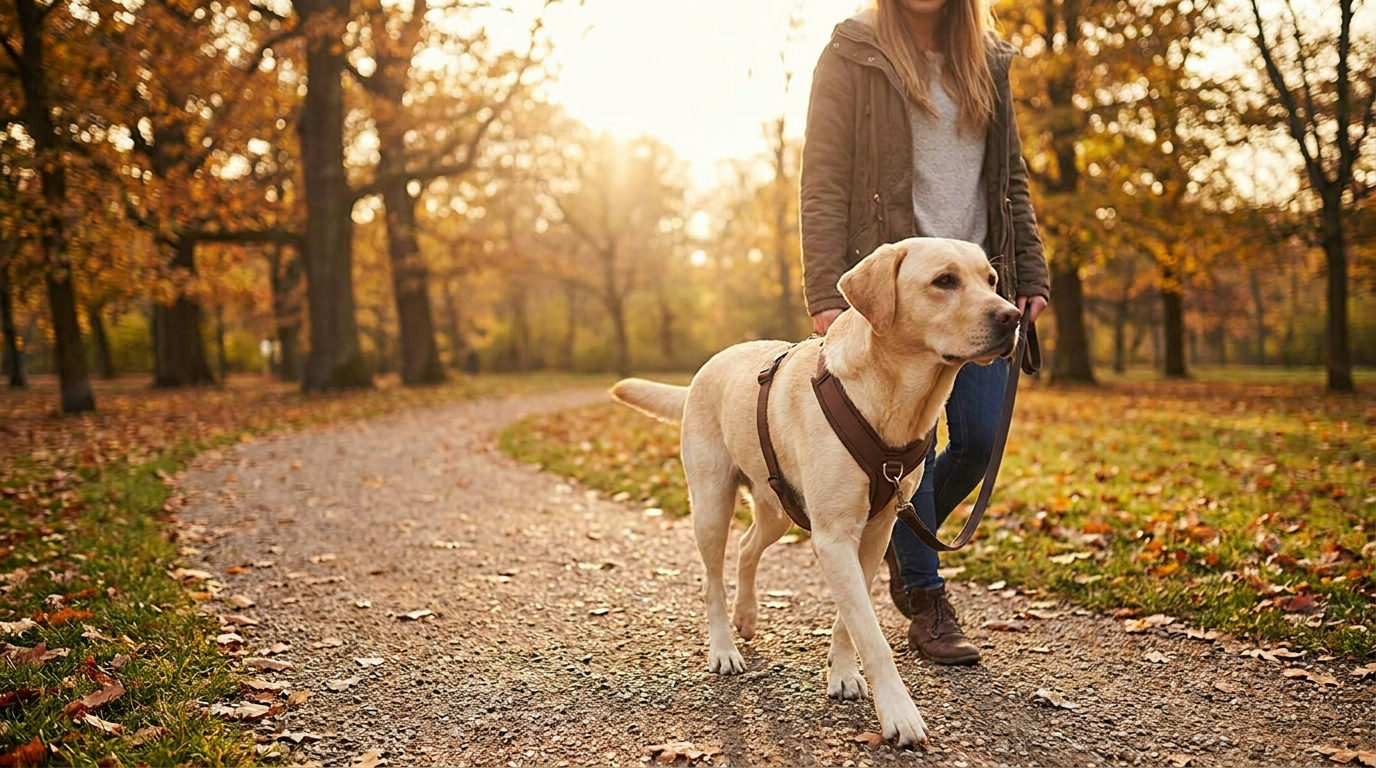
The right harness for a Labrador depends on one question more than any other: does your dog pull? For a strong, enthusiastic puller, a front-clip or dual-clip harness usually gives you more control. For a dog that already walks nicely, a comfortable back-clip harness is simpler to use. Either way, fit matters more than brand, and a harness is a management tool that works best alongside loose-lead training.
Affiliate disclosure: Labrador Healthcare may earn a commission if you buy through links on this site, at no extra cost to you. We have not hands-on tested specific products for this guide; it sets out the selection criteria we use and recommend.
Why a harness suits many Labradors
Labradors are strong, broad-chested and famously keen to get wherever the smell is. A flat collar puts all of that force on the neck. A well-fitted harness spreads it across the chest and shoulders instead, which many owners find more comfortable for the dog and easier to handle.
A harness is not a substitute for training. It changes where the lead attaches, not why your dog pulls. Used well, though, it can make training walks calmer and safer while your Labrador learns.
The main harness types explained
Back-clip harnesses
The lead clips on the dog’s back, between the shoulder blades. In the American Kennel Club’s guide to choosing a harness, a veterinarian recommends back-clip styles for well-trained dogs, largely because they are quick to put on and the lead is less likely to tangle. The downside for a determined puller is that a back clip can make pulling easier, a bit like a sled harness.
Front-clip harnesses
The lead clips at the centre of the chest. When the dog surges forward, the lead turns it gently back towards you. The AKC guide describes front-clip designs as helpful for dogs that pull. They can take a moment longer to clip on, and the lead can end up under a front leg if you let it go slack.
Dual-clip harnesses
These have a ring on the chest and another on the back. You can start with the front clip for control and move to the back clip as your dog improves, or use a double-ended lead attached to both. For a young Labrador still learning lead manners, this flexibility is often the most practical choice.
No-pull harnesses with a tightening loop
Some “no-pull” designs add a strap or loop that tightens a little when the dog pulls. They can help owners who are smaller than their dog or walking with a pushchair, but they must fit well, and any design that restricts shoulder movement is worth avoiding for daily use.
How to choose a harness for a Labrador: our criteria
- Shoulder freedom. Look for a Y-shaped front, where straps run either side of the neck and down the breastbone. Avoid straps that sit straight across the front of the shoulders, which can interfere with a dog’s natural stride.
- Adjustability. At least four adjustment points (two at the neck, two at the girth) help you fit a deep Labrador chest properly.
- Padding where it rubs. Soft padding under the chest and behind the front legs helps prevent chafing, especially on long or wet walks.
- Strong hardware. Metal D-rings and robust buckles matter on a dog that can hit the end of the lead at speed.
- Reflective trim. With autumn and winter walks in the dark, reflective stitching or panels are genuinely useful.
- Easy to wash. Labradors find every puddle. A harness that can be hand-washed and dries quickly will last longer.
Getting the fit right
Measure before you buy. Use a soft tape around the widest part of the ribcage, just behind the front legs, and around the base of the neck. Compare those numbers with the maker’s size chart rather than relying on weight bands.
Once it is on, check that you can slide two fingers under every strap, that the harness does not rub the armpits when your dog walks, and that it does not twist to one side. If your Labrador can reverse out of it, it is too loose. Puppies and young dogs grow fast, so recheck the fit every few weeks.
Introducing a harness
Some dogs dislike things going over their head. Take it slowly: let your Labrador sniff the harness, reward calm interest, then practise putting it on and taking it off for a treat before you ever clip a lead to it. A few short sessions usually turn the harness into a signal that a walk is coming.
Pair the harness with training
The harness buys you control; training builds the habit. Reward your dog for walking with a loose lead, stop when the lead goes tight, and keep sessions short and upbeat. Our guides to Labrador lead-pulling tips and loose-lead walking walk you through it step by step.
The bottom line
For most pulling Labradors, a well-fitted front-clip or dual-clip harness with a Y-shaped front is the practical starting point. For calm walkers, a padded back-clip harness is simple and comfortable. Measure carefully, check the fit often, and treat the harness as a helper for training rather than the whole solution.